 How-to
How to Fix Low Water Pressure in Your Home
Last Updated: November 27, 2026
Quick Summary
To fix low water pressure, first diagnose whether the problem is at one fixture or the whole house, since a weak shower alone points to a clogged showerhead while weak flow everywhere points to your main line, pressure-reducing valve, or utility. Then clear clogs, check valves, and measure static pressure with a screw-on gauge.
- A weak shower alone points to a clogged showerhead or failing cartridge.
- Weak flow everywhere points to your main water line, pressure-reducing valve, or utility.
- Measure static pressure with a screw-on gauge sold at any hardware store.
- If the meter dial spins with every tap closed, water is moving somewhere it should not.
- Soak a clogged showerhead in vinegar overnight to break down mineral buildup.
Table of Contents
- Diagnose the Source: One Fixture or the Whole House?
- Why Is Water Pressure Low in the House Suddenly?
- How to Fix Low Water Pressure at a Faucet
- How to Fix Low Water Pressure in a Shower
- Hot Water Pressure Low but Cold Fine: What It Means
- Schedule a Professional Diagnosis with The Plumber Guys
- Frequently Asked Questions
Diagnose the Source: One Fixture or the Whole House?
Learning how to fix low water pressure starts with one question: is the problem at a single fixture or across the whole house? That answer decides everything that follows. A weak shower alone points to a clogged showerhead or a failing cartridge. Weak flow everywhere points to your main water line, your pressure-reducing valve, or the water utility itself.
This guide walks you through that diagnosis step by step, then shows you the fix for each case.
Start with a simple walk-through of your home:
- One fixture weak? The problem lives at that fixture.
- Every fixture weak? The problem lives in your supply system.
- Only hot water weak? Suspect the water heater or its supply line.
- Only upstairs weak? Suspect height, pipe size, or a failing booster pump.
Write down what you find so you can focus on the likely cause.
Check Hot and Cold Water Separately
Run the hot tap, then the cold tap, at the same sink. Compare the flow.
If both are weak, the problem sits in the shared supply line or valve. If only hot is weak, the cold side is fine and the fault is in the water heater or its plumbing. That single test narrows your search fast.
Measure Static Pressure Safely
Static pressure is the resting pressure in your pipes when no water is running. Measuring it takes a screw-on pressure gauge, sold at any hardware store, and about five minutes.
- Screw the gauge onto an outdoor hose bibb or a laundry sink faucet.
- Make sure no water is running anywhere in the house.
- Open the valve fully and read the dial.
- Close the valve and remove the gauge.
Healthy household pressure usually sits in a comfortable mid-range. Very high readings stress pipes and fixtures. Very low readings explain weak flow everywhere. If your reading looks extreme in either direction, stop adjusting and consult a licensed plumber. Too much pressure can burst a supply line.
guidance on household water pressure and pipe safety
Why Is Water Pressure Low in the House Suddenly?
A sudden drop across the whole house almost always traces to one of four things: a partly closed main shut-off valve, a failing pressure-reducing valve, a break or leak in the main water line, or work being done on the municipal water supply. Gradual drops are different. They usually come from mineral buildup or a slowly failing valve.
A short decision tree can narrow the cause before you touch a wrench. Work through these questions in order:
Step 1, Where is the pressure low?
- One fixture only: go to that fixture. The cause is almost always a clogged aerator, a failing cartridge, or a kinked supply line. Skip to the faucet and shower sections below.
- One floor or one wing: suspect a fixture shut-off valve that is partly closed, a kinked branch line, or, in a multi-story home, height and pipe size. Check the nearest shut-off valves first.
- Whole house: continue to Step 2.
Step 2, Is it hot, cold, or both?
- Both hot and cold weak: the problem is in the shared supply, main valve, meter, PRV, or the utility line.
- Only hot weak: the fault is on the hot side, water heater sediment, a failed dip tube, a closed valve on the hot outlet, or a kinked hot supply line. See the hot-water section below.
- Only cold weak: less common, but check the cold-side shut-off valve and the supply line to the fixtures affected.
Step 3, Was the drop sudden or gradual?
- Sudden, whole house: check the main shut-off valve first (it may have been left half-closed after repairs), then the meter for a spinning dial that signals a leak, then call the utility to ask about work in the area. A main-line break on your side of the meter is a plumber call; on the utility side, it is the utility's responsibility.
- Gradual, whole house: suspect the PRV, corrosion, or sediment. Start with a static pressure reading and a visual inspection of the PRV.
- Sudden at one fixture: clogged aerator or failed cartridge.
- Gradual at one fixture: mineral buildup in the aerator or showerhead.
Step 4, Check the meter for a leak.
With every tap closed, watch the water meter dial for a minute. If it spins, water is moving somewhere it should not. A leak steals pressure and can quietly damage your foundation or landscaping.
Here is a summary of the possibilities:
| What You Notice | Likely Cause | Where to Look |
|---|---|---|
| Sudden drop, whole house | Closed valve, main break, utility work | Main valve, meter, utility |
| Gradual drop, whole house | Failing PRV, corrosion, sediment | Pressure-reducing valve |
| One fixture only | Clogged aerator, cartridge, showerhead | That fixture |
| Hot water only | Water heater, dip tube, supply line | Water heater |
| Upstairs only | Height, pipe size, booster pump | Booster pump, pipe run |
| Meter spins with taps closed | Leak in supply line or fixture | Meter, main valve, visible pipes |
Write down your answers to Steps 1 through 3 before you start any repair. That short record gives a plumber a clear starting point if you decide to call one.
How to Fix Low Water Pressure at a Faucet
A weak faucet is usually a clogged aerator. Unscrew the aerator from the spout by hand or with pliers wrapped in a cloth.
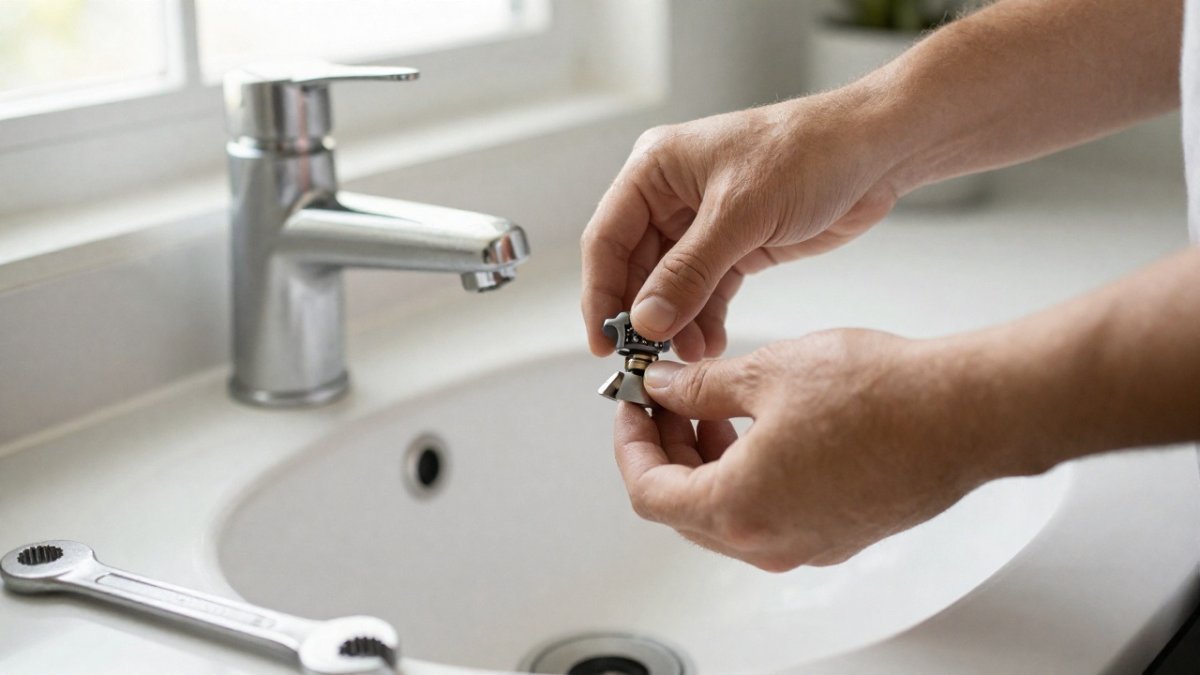
If the aerator is clean and flow is still weak, the faucet cartridge is the next suspect. Shut off the fixture shut-off valve under the sink, remove the handle, and pull the cartridge.
Also check the supply line under the sink for a kinked hose. A bent braided line chokes flow just as surely as a clog.
How to Fix Low Water Pressure in a Shower
A weak shower almost always means a clogged showerhead or a failing cartridge. Unscrew the showerhead and soak it in vinegar overnight to break down mineral buildup. Clear the small screen inside, then reinstall.
If that doesn't restore flow, check the shower valve cartridge. A worn cartridge restricts hot and cold flow and often causes a sudden pressure change. Shut off the water at the fixture valve before you open the valve body.
Low flow upstairs in a multi-story home can also come from height and pipe size. Water loses pressure as it climbs. A booster pump can solve this, but only after you rule out clogs and valve problems.
Hot Water Pressure Low but Cold Fine: What It Means
When hot water pressure is low but cold runs fine, the fault sits on the hot side of your system. Common causes include:
- Sediment buildup inside the water heater
- A failing dip tube that lets hot water escape at the top
- A clogged or kinked hot supply line
- A closed valve on the hot water outlet
Flushing the water heater removes sediment and often restores flow. If the heater is old and the dip tube has failed, replacement is usually the better call. A licensed plumber can confirm which part is at fault before you spend money on parts.
water heater maintenance and sediment guidance
Schedule a Professional Diagnosis with The Plumber Guys
Some low-pressure problems need a trained eye, especially when the cause sits inside a PRV, the main line, or the water heater. That is where The Plumber Guys comes in.
You can review our full range of services, read what past customers say in our customer reviews, and confirm your location on our service areas page before you call. For current prices or a quote, see our pricing page.
Low water pressure rarely fixes itself, and guessing at parts gets expensive fast. Let The Plumber Guys trace the cause with a pressure gauge and a trained eye, then give you a straight answer on the repair.
Frequently Asked Questions
Why is the water pressure low in my house all of a sudden?
A sudden drop usually points to a change in the supply, not gradual buildup. Check whether a neighbor is running water heavily, whether the main shut-off valve was bumped partly closed, or whether your water utility is doing work nearby. Inside the home, a failing pressure-reducing valve or a partially closed fixture valve can cause it. If the drop happened overnight and affects every tap, start at the main valve and meter before tearing into fixtures.
Why is my hot water pressure low but my cold water is fine?
When hot water pressure is low but cold runs normally, the restriction sits between the water heater and the fixtures. Common culprits are sediment buildup in the tank, a clogged hot-side supply line, or a failing shut-off valve on the heater. Flushing the water heater and checking the hot outlet valve are the first steps. If the heater is old and sediment is heavy, replacement may cost less than repeated repairs.
Is 40 psi water pressure too low?
Forty psi is on the low end but generally workable for a household. Many households run comfortably in that range. Below 40 psi, showers feel weak and appliances like dishwashers may struggle. If your gauge reads under 40 at a hose bib, check the PRV setting and the main valve before assuming a pipe problem.
When should I call a plumber about low water pressure?
Call a professional if you have checked the aerators, showerhead, fixture valves, and main shut-off valve and pressure is still low. Also call if you suspect a hidden pipe leak, if the PRV needs adjustment beyond its safe range, or if pressure drops suddenly across the whole house. The Plumber Guys offer 24/7 emergency service.
